Cobra Power Brake Modification
R. Bickle 3/2018
The Lone Star Classics cobra was not designed with power brakes in mind, although some people have modified them with power brake boosters. My car had an additional problem because I had cut out and moved the firewall forward 2 inches in order to move the pedals forward and create more leg room. This left only about 6 inches total between the firewall and the wheel well, creating a challenge to mount a power brake booster.
I initially planned to use a hydroboost system, and even purchased a hydroboost unit, but the unit itself was as big as the area it would mount in, not even considering the master cylinder. I researched vacuum brake boosters, and found that the C4 corvette used a 9” booster, which was very thin. I purchased an aftermarket metal unit (the originals were plastic). I modified the firewall plate to mount the booster and modified the pedal linkage to connect to the input shaft without modifying the booster itself.
Once I could see that the booster would fit, the remaining job was to find a way to mount a tandem master cylinder. I had elected to use the Wilwood tandem remote master cylinder, as the rest of the braking system is all Wilwood parts. This unit is 7” long and with the vacuum booster installed, I had about 4” of space remaining front to back. Rather than cut into the wheel well and have the master cylinder protrude into it 3+ inches, I decided to design and build a mechanism to turn the booster force 90 degrees.
The cad drawing for the mechanism:
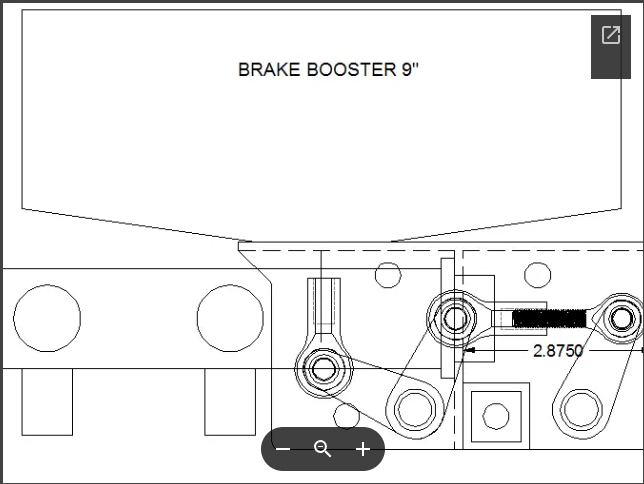
The output shaft of the booster couples to a 5-16” Teflon lined Heim joint (A). This pushes on a 1.5” arm, rotating the left shaft counterclockwise (B). This in turn, pulls the Heim joint linkage at the upper right (C), and causes the right shaft to rotate in the same manner as the left (D). A second arm on the right shaft, positioned directly below the one visible in the drawing, pushes on the master cylinder.
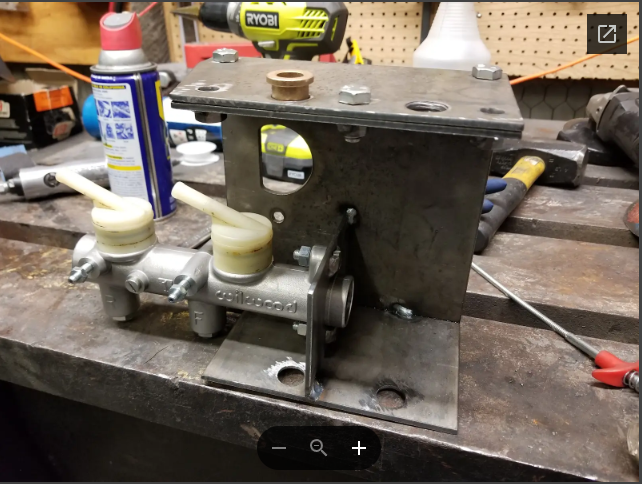
Once the dimensions of all components were designed, they were cut from 1/8” mild steel using a CNC plasma table. The pieces were assembled and tack welded to verify fit with each other and fitment inside the car.
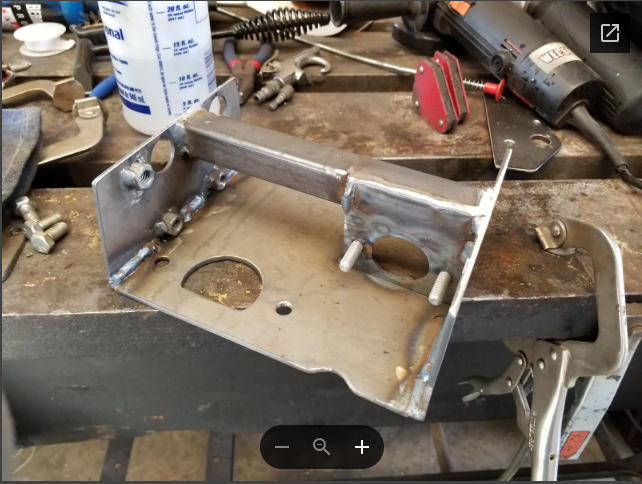
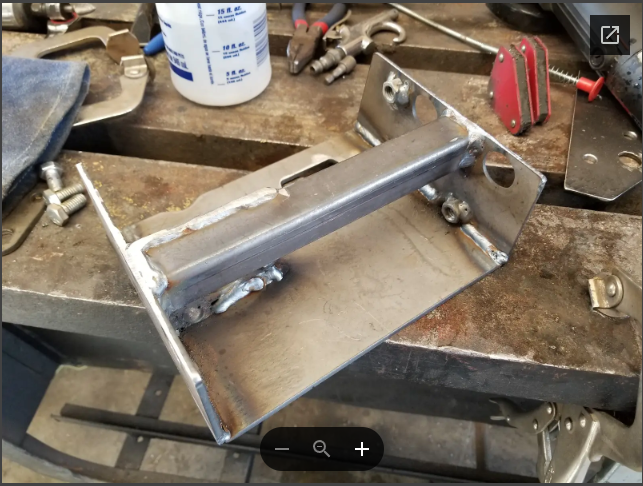
Initial welding of the framework and fasteners:
Bronze bushings and shafts added:
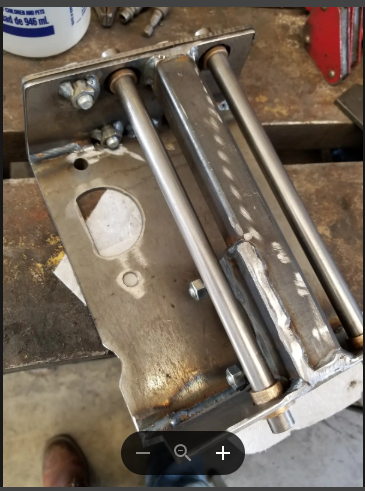
Note the top plate with bushings pressed in is bolted to the top of the framework. This allows the shafts to be installed and removed if needed.
Testing the fit of the master cylinder:
Once the fit was tested and parts found to function properly, the unit was disassembled and everything was sandblasted and powder coated. Here is the unit test fitted to the booster and master cylinder:
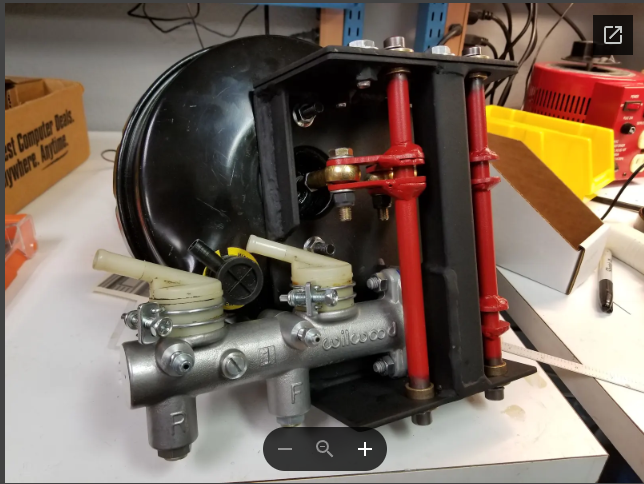
The connection between the brake booster and the first Heim joint is critical. The brake booster output shaft (yellow arrow above) has a threaded bolt inside which is normally used as an adjustment to eliminate play between the output shaft and the master cylinder piston. In order to firmly couple the booster output shaft to the contraption, I machined a piece of ½” hex stock with a 6mm thread on one end, and a 5/16” thread on the other. The 6mm end with a piece of 6mm shaft couples to the booster shaft, while the 5/16” thread couples to a male Heim joint on the other. This rigid connection insures that the booster can never lose coupling with the rest of the system.
Here you can see the arm and shaft pressing the master cylinder piston (yellow arrow):
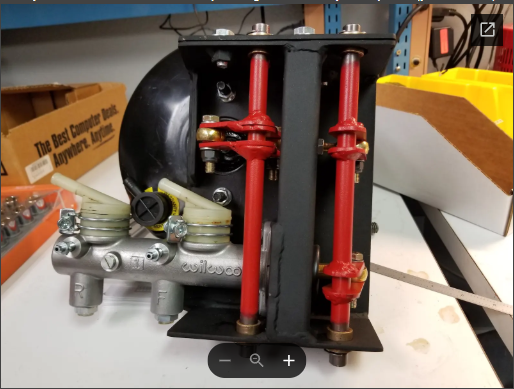
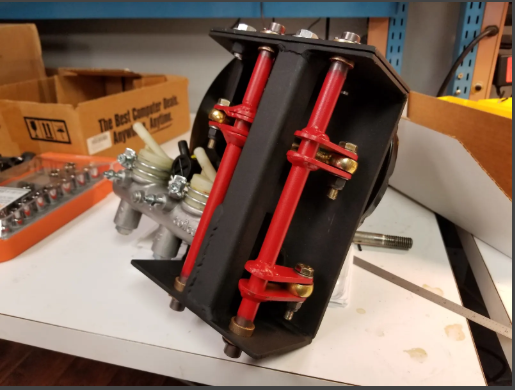
Before welding on the arms, I turned grooves in each end of the shafts on the lathe for E-clips. These prevent the shaft from moving vertically. Note the fit of the booster check valve between the master cylinder fluid connections.
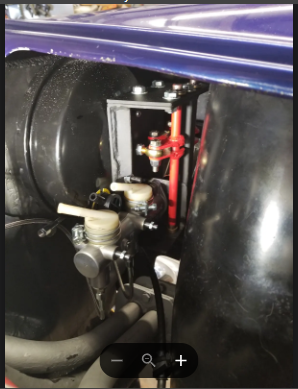
Brake contraption, booster and master cylinder fitted on the cobra. Not much space left:
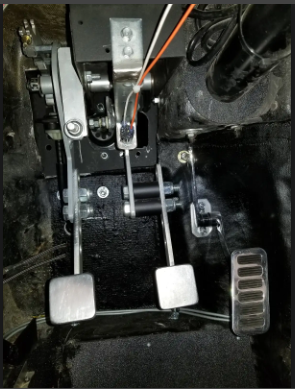
Brake pedal modifications:
R. Bickle 3/2018
The Lone Star Classics cobra was not designed with power brakes in mind, although some people have modified them with power brake boosters. My car had an additional problem because I had cut out and moved the firewall forward 2 inches in order to move the pedals forward and create more leg room. This left only about 6 inches total between the firewall and the wheel well, creating a challenge to mount a power brake booster.
I initially planned to use a hydroboost system, and even purchased a hydroboost unit, but the unit itself was as big as the area it would mount in, not even considering the master cylinder. I researched vacuum brake boosters, and found that the C4 corvette used a 9” booster, which was very thin. I purchased an aftermarket metal unit (the originals were plastic). I modified the firewall plate to mount the booster and modified the pedal linkage to connect to the input shaft without modifying the booster itself.
Once I could see that the booster would fit, the remaining job was to find a way to mount a tandem master cylinder. I had elected to use the Wilwood tandem remote master cylinder, as the rest of the braking system is all Wilwood parts. This unit is 7” long and with the vacuum booster installed, I had about 4” of space remaining front to back. Rather than cut into the wheel well and have the master cylinder protrude into it 3+ inches, I decided to design and build a mechanism to turn the booster force 90 degrees.
The cad drawing for the mechanism:
The output shaft of the booster couples to a 5-16” Teflon lined Heim joint (A). This pushes on a 1.5” arm, rotating the left shaft counterclockwise (B). This in turn, pulls the Heim joint linkage at the upper right (C), and causes the right shaft to rotate in the same manner as the left (D). A second arm on the right shaft, positioned directly below the one visible in the drawing, pushes on the master cylinder.
Once the dimensions of all components were designed, they were cut from 1/8” mild steel using a CNC plasma table. The pieces were assembled and tack welded to verify fit with each other and fitment inside the car.
Initial welding of the framework and fasteners:
Bronze bushings and shafts added:
Note the top plate with bushings pressed in is bolted to the top of the framework. This allows the shafts to be installed and removed if needed.
Testing the fit of the master cylinder:
Once the fit was tested and parts found to function properly, the unit was disassembled and everything was sandblasted and powder coated. Here is the unit test fitted to the booster and master cylinder:
The connection between the brake booster and the first Heim joint is critical. The brake booster output shaft (yellow arrow above) has a threaded bolt inside which is normally used as an adjustment to eliminate play between the output shaft and the master cylinder piston. In order to firmly couple the booster output shaft to the contraption, I machined a piece of ½” hex stock with a 6mm thread on one end, and a 5/16” thread on the other. The 6mm end with a piece of 6mm shaft couples to the booster shaft, while the 5/16” thread couples to a male Heim joint on the other. This rigid connection insures that the booster can never lose coupling with the rest of the system.
Here you can see the arm and shaft pressing the master cylinder piston (yellow arrow):
Before welding on the arms, I turned grooves in each end of the shafts on the lathe for E-clips. These prevent the shaft from moving vertically. Note the fit of the booster check valve between the master cylinder fluid connections.
Brake contraption, booster and master cylinder fitted on the cobra. Not much space left:
Brake pedal modifications:
